Friday, February 27, 2009

Steven's Pass ..

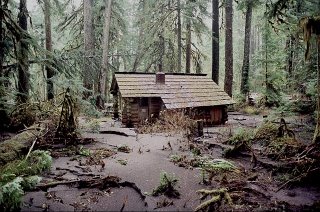
Ken and I opted to use our free passes to Steven's Pass on the last Friday of operations. The weather wasn't forecast to be great, but we were going anyway. After all, you can't be a Pacific Northwest skier without skiing in the rain at least once a year.

The first ride up the chair was cloudy, but no precip. The second ride up involved rain that turned into "Wintry Mix" near the top. By the third time up, we had that precip freezing on the outsides of our shell pants.

First chair ride up.

The snow was decent on groomed runs and corn like at times with icy patches and some thicker patches. Anything that was not groomed was heavy, wet and hard to turn in. We stuck to Hog Heaven, and Barrier Ridge for our first few runs then decided to see what the other side of the ridge was like.

We rode the Tye Mill Chair up to the top and then went down Gemini which felt like the best run of the day so far. There was no one on the backside, and the weather was somewhat better. That changed, and the wind kicked up and the rides up the Jupiter Chair had us getting blasted in the face with icy pellets. After 3-4 runs down time was running out on the backside (they close the lifts at 3:15pm) so we decided to get back on the front of the ridge.

We had a few super enjoyable runs down The Crest Trail and Skid Road before making a few last runs down Skyline as the skies turned blue and we warmed up and dried out.

Overall we had a great day. The snow was pretty good where it had been groomed, or where lots of people were skiing. We stuck to all blue runs as the black diamonds were not groomed and not too many people were skiing them. The snow in those areas was not appealing, and neither Ken nor I were looking to get injured on our last day of lift served skiing this season.

Last chair of day.

Friends


Stormy and the dogs are friends.See more photos of the dogs at my other blog - the puppy tale - at blogspot.com (for some reason the link refused to come up here. It is in the labels below)

Thursday, February 26, 2009

Taking Down Sunflowers


My neighbor had a huge bunch of wild sunflowers in her yard that had about bloomed theirselves out. She asked my son to take them down with his tractor as it was such a big job to do by hand. So down came the sunflowers. It was even a job for the tractor. But it did displace one little cottontail rabbit. I am sure it was able to find a new home out in the desert under a sagebush.


Wednesday, February 25, 2009

Rain Clouds

Recently it seems like everytime I look out there are beautiful clouds in the sky. I can't take photos of all of them and this is just a few. The first one shows a curtain of rain as it moves across the desert.


Monday, February 23, 2009

Roe-Dee-Oh :: Steer Wrestling

Sunday, August 21st - - Some had better luck than others...


The Rab Infinity Down Jacket


Mr. Rab Carrington himself, at a crag in Osp, Slovenia. photo couresty of Veronika


The "RAB" stands for Rab Carrington. For guys like me of a similar generation Rab Carrington was one of the hard Brits running around the Alps and later the greater ranges knocking off the plums.


"In the 70’s, you weren’t a rock climber, you were a mountaineer. In winter you ice climbed, in spring you tried to get rid of the winter fat, in the summer you went to the Alps, then you did a bit in the autumn before it closed in for the winter - the drinking season.


In 73/74 we started going to the Alps in winter. We went out, a team of Brits, not knowing much, doing our own thing. We were aiming for a speedy style, but the first route took Al and me two days, and we later found out that Patrick Vallençant had skied down it in about 15 seconds.


The whole team of us shared an apartment. That was a wild time, totally drunken and debauched. We didn’t get our deposit back at the end of the season, that’s for sure.


I learned how to make sleeping bags by accident. Al Rouse and I had a completely abortive trip to Patagonia in 1973, when we travelled overland from the USA. We got to Buenos Aires to pick up our climbing gear - which was being shipped out from Liverpool - only to find the gear hadn’t even left the port thanks to a dock strike. We partied instead, but I also ended up working for Hector Vieytes, a friend of mine, for six months in Argentina, and that’s were I learnt the basics.


I fell out with Al Rouse in Kangtega. We were very successful, Al and I, and had gone on lots of great trips together over the years. We’d just done Jannu in 1978, were going to Kangtega in 1979, then on to meet Doug Scott and go to Nuptse, then Makalu the year after, then we’d a chance at Everest. But we’d grown apart, we had a different emphasis. He was more into publicity and success Ă  la Bonington, I was less in to that - we separated.


I started my business when Liz, my daughter came along in 1981. It was the only thing I knew how to do. I worked on a building site in the day and in the evenings I sat upstairs in the attic and sewed sleeping bags."


More here:

http://www.thebmc.co.uk/Feature.aspx?id=1685


The reason I mention Rab's history is I am convinced a basis in hard alpinism is the design genius behind a lot of innovative and quality gear. Problem is there are a lot of pretenders out there with neither design genius or building quality gear. And the climbing public seldom knows the difference. Give enough shit away and sponsor the right people with a slick multimillion dollar catalog campaign and all is "right" with the world. Right of course till the "shit" fails by design or by lack of quality.


I am a huge fan of down as insulation. Sadly I don't generally climb where is it dry enough to use it a lot these days.


Alaska sure. In the Alps? Not so much for what I have been doing recently. May be this spring that will change. My buddy Jon Griffith thinks down is the sheet for climbing jackets.Here in the Cascades..you are a dead duck. In Canada...on the ice fields, or the big faces? Sometimes. Around town? Sure.


Jon's hard won suggestions:


http://www.ukclimbing.com/gear/review.php?id=3533


There are a few down garments I have no problem recommneding if used i nthe rght conditions.


Theexcellent Norrona Lyngen and Eddie Bauer Peak XV jackets are two. More here:


http://coldthistle.blogspot.com//03/design-triumphsthe-norrna-lyngen-down.html


http://coldthistle.blogspot.com//02/belay-jacketsthe-heavy-weights.html


As slick as the Norrona is it is a bit heavy for somethings as is the XV when you start adding them to your pack.


I have a bunch of down sweaters, the previous Eddie Bauer pullover Hoody being one of the best and most used. But is is a pullover which limits the garment's use I find. And most of the time if I want down I want more than a sweater weight garment.


Enter theRab "Infinity:". It has a little more loft than a sweater, packs smaller and wasobviously designed by a team that knows about "fast, light and warm". The down is 850 fill.


Here are the factory specs:


◦NEW Pertex® Quantum 10D ultra light rip stop nylon outer and lining


◦Stitch-through baffle construction

◦210g/7oz of down fill. (L) of 850 fill power superior quality European white goose down

◦Lycra edged fixed down filled hood

◦2 hand warmer pockets with YKK zips

◦1-way YKK front zip and mini internal insulated zip baffle with chin guard

◦Elasticated cuffs

◦Double exit hem drawcord

◦Short cut


I got my XLa month or so ago. It weighs 17.5 oz on my scale...close enough to the advertised over all weight of16oz/460g for a large. I spent a day in a light rain with it and the material was still shedding water when I finally added a shell. I like the cut and the amount of insulation you get for the weight involved. Like many really good pieces of kit, it is a simple product with a very complicated design.

And imo this one is done right.


Of all my down gear, the Infinityis a piece that finally fits in where I thought a good piece of kit was needed. It is a small niche market for climbers but the RAB Infinityis one well worth looking at. if you have similar needs.


The Eddie BauerSweater pictured aboveat -30C. The RAB "Infinity" bumpedit inmy line up because of the better design and materials used for cold alpine climbing by RAB.


Credit where it is due? Eddie Bauer has a price point that is difficult to ignore forhigh quality down garments. The original Down Hoody is an excellent bit of kit.


RAB Infinity Jacket is $280 retail. The Eddie Bauer Hooded Down Sweater is $200. The $80 difference? While both are sewn through, The RABis a "jacket" and the EB a "sweater" in my opinion both with appropriate levels of insulation.
Sunday, February 22, 2009

Loons!


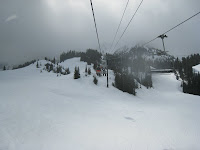
Yesterday we found another Loon nest so today we are heading up to watch it and see if the chicks hatch.


Well, after 9 hours of watching the Loon nest the eggs got turned several times by the adult, but so far they haven't hatched. The one that was on the nest got off the nest 3 times throughout the day and went for a swim while the other adult stayed out on the lake. I'm guessing it was Mom doing all the work :-)

Thursday, February 19, 2009

Mt Rainier Storm & Flood Damage Photos - Carbon/Ipsut

The NW corner of the park usually has its own share of flood related damage each year. And though it's not unusual for there to be Carbon River inspired washouts, this rainstorm brought substantially more destruction to the area. For example, here is the idyllic Ipsut Creek Cabin. It suffered heavily during the flood. Is it me, or does this place remind you of Yoda's house on Dagoba?
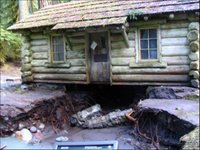
This creek diversion gives literal meaning to the name, Ipsut Creek Cabin. If Yoda did live here, he'd have to use quite a bit of "the force" to fix things.
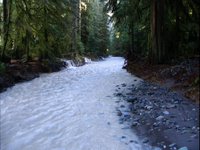


As for the Carbon River Road, more than two miles of it washed away in at least four separate spots. In some places, the river flowed down the middle of the road (like here). For climbers, this could spell delay in early season attempts of Liberty Ridge.
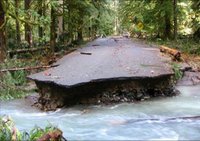


AND another washout closer to Ipsut Creek Campground.


As for the Wonderland and other park trails, here's a brief run down on the storm damage. Keep in mind, the full extent may not be known till next spring, as these assessments were made from the air. For now, backpackers should probably expect things (bridges) to open up later than normal next summer. There are at least 10 bridges out around the Wonderland Trail. New trail needs to constructed in four other places. That includes a half mile reroute between Lake James and Cataract Creek and another 750 foot section in Stevens Canyon. NPS Photos

NGS Recap :: Fantastic!

First of all, I have to agree with many of the other genea-bloggers who have posted their thoughts about the NGS Conference in Cincinnati - IT WAS FANTASTIC!


All of the sessions I attended, with the exception of one, were excellent. And the company was incredible. It was so much fun meeting and spending time with “old friends” whom I knew through their blogs as well as meeting some new ones.


Of course, I spent a lot of time with my room-mate Laura Cosgrove Lorenzana and hung out a lot (during sessions and lunches and evenings) with Susan Clark, Linda McCauley, Tina Lyons, and Shelley Bishop. I also met Amy Johnson Crow, Kathy Reed, Lori Thornton and several others whose names I don't recall at the moment!


Two social highlights for me came on Saturday - the first was when a blog reader, Linda Edwards, caught my attention as a group of us were walking into the Hyatt after the sessions were over. She recognized me and I'm very glad that she came forward and said so! It was a really neat moment. Thanks, Linda!


Later that evening after supper at Champs with Kathy, Susan, Linda, and Laura we were relaxing and talking with each other when DearMyrtle came in. She sat down and chatted with us for a while then moved on over to her supper group. From what I understand, Laura and I left too soon - an hour or so later some of the more well-known speakers, including Elizabeth Shown Mills, came into Champs. I'm sure that Susan and Linda enjoyed their time rubbing shoulders with the “rock stars” of genealogy!


As I stated above, all of the sessions I attended (except one) were excellent. All of the presentations by Thomas Jones and Elizabeth Shown Mills were filled to capacity but luckily I was able to get into all of them. It was worth getting there a bit early or waiting in a long line to enter their sessions. Even though I have no intentions of becoming a “professional” genealogist, the practices they espouse regarding documentation, research reports, etc. can be put to use in my own research - hopefully making it better. I discovered that in some ways I already use some of the concepts they talked about but definitely not to the fullest extent.


The last session by Mills was partially titled “Information Overload” and it was appropriately named for by that time my head was nearly bursting with so many ideas and so much new information and thinking about how to apply it all to my research in the hopes of finding some of those elusive ancestors!


Lori Thornton and Becky Wiseman (photo taken by Susan Clark).


Susan Clark and Becky Wiseman (photo taken by Lori Thornton).


The view across the Ohio River from our balcony seating at the Moerlein Lager House on Thursday evening.


Supper was a braised short-rib grilled cheese sandwich with sweet potato chips. It was oh, so good! Laura had the shrimp tacos shown in the background. And yes, a little beer was imbibed.


The conference was over and everyone was homeward bound. Tina Lyons stopped to say goodbye as I was watching the vendors below dismantle their displays.


I want to thank everyone I met but especially Laura for being my room-mate and Susan, Linda, Kathy and Tina for allowing me to tag along to lunches and spending some time with them in the evenings. It truly made the conference more special for me! Thanks, everyone! It's such an understatement, but I had a great time...


Fat Pony


Here is Jack and my mare, Nita having a confab about not getting enough attention. Yeah, I agree, BlackJack is over weight. All of my horses seemed to suddenly get over weight in the past month or so. No, I haven't been riding enough, or doing ground work with them. Either I don't feel like it, or it is raining, or muddy, muddy, or I am busy at my job, or cleaning pens, and making sure water buckets are clean and full. It seems there are never enough hours in the day.

Wednesday, February 18, 2009

Walk on the Desert

went for a walk on the desert the other day and saw some interesting plants. The dogs trailed something that was most likely a rabbit. Was a nice day.


Little Bighorn


From Wikipedia:

The Battle of the Little Bighorn (also known as Custer's Last Stand), was an armed engagement between a Lakota-Northern Cheyenne combined force and the 7th Cavalry Regiment of the United States Army. The battle occurred on June 25th and 26th, 1876 near the Little Bighorn River in eastern Montana Territory, near what is now Crow Agency, Montana.

From the Little Bighorn National Monument website:

This monument memorializes the U.S. Army's 7th Cavalry and the Sioux and Cheyenne in one of the last armed efforts to preserve the way of life of the Plains Indians. 263 soldiers and attached personnel of the U.S. Army, including Lt. Col. George A. Custer, died fighting several thousand Lakota and Cheyenne warriors.


I have been wanting to visit the site of the Battle of the Little Bighorn for quite a few years, and since my travel route was taking me that way I decided to take advantage of it and plan my travels so that I would have a couple of hours to visit the monument. I did a quick tour of the small museum and after a nice chat with the young Crow man that was working the contact desk I took a walk out to view the battle field. It was very surreal to be standing on the hillside, viewing the grave markers and to be imagining all the fighting that occurred there.


Above and below: Iron sculpture of warriors on horseback.


Easily the most powerful part of the memorial was the wall which listed the names of the different native warriors that lost their lives in the Battle of the Little Bighorn. After reading all of the names I left some tobacco and continued on my way.